
Memorial
24 March 2k9
In Memorial~Prince William Sound 1989
~*~
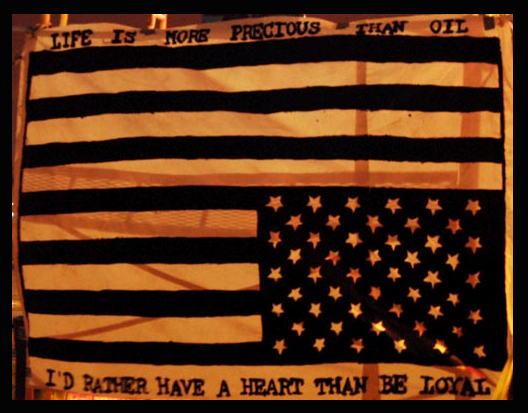
- Never Forgive, Never Forget
poem for twenty years
I know it’s unlikely that before,
upon my life darkness falls,
that I will have gotten hold
of Exxon Corporation by the balls.
Still, if by some mighty miracle
this should ever be so
I’d close ’em down and,
tarred and feathered,
make ’em go
straight to the Hell
which they have
so richly earned.
And finally,
in their own stinking oil,
forever they would be burned.
~D.C. McKenzie
—end transmission—
Beacons in the Darkness
21 March 2k9
“You cannot will yourself to write a poem, as you cannot will yourself to be struck by lightning.” ~Robert Pinsky
“Everywhere I go I find that a poet has been there before me.” ~Sigmund Freud
In 1999, the United Nations Educational, Scientific and Cultural Organization (UNESCO) declared that March 21st. would thereafter be celebrated as World Poetry Day. As a poet, though some would argue for ‘fool’ as an identifier instead, I would like to extend my sincere thanks to UNESCO for recognizing this vital art form; which over thousands of years has been for humanity a beacon in the darkness, around which we cling to each other; an art which has illuminated and strengthened the umbilical connections between our minds, our souls and the Universe we call home. Therefore, in honor to my peers, and with gratitude to our patrons and readers, I offer a poem…
Brian Calls
From the Schaumburg Woods
north of Chicago. Walking in such melancholy
places helps my friend mourn, and for me
nothing more of Why need be asked.
It is fall, but within the thin wood there are
katydids and cicadas singing yet. A raccoon came
to see what sort of nuisance the human was about
and, satisfied, left without saying a word.
Nevermind the airplanes above, Brian says—
Here all is enrapt with sunset,
full to brimming with sunset:
barely-hardened amber, plum, ocher, and delicate russet
reflects from the mirror of a murky pond.
Under such light, the vaulting boles of mossy trees
have been reforged into pillars of marble amidst the undergrowth,
veined in van Gogh yellow, cream copper and emerald;
ruins perhaps, of a long-forgotten Temple to the Sun.
Now tuned to the subliminal song of this place,
his grief seeps into the ground, is painted into the landscape,
such that the next wanderer to venture here
will surely find the place haunted.
Tramping amongst the white-noise crackle of leaves,
which lie colorful upon countless generations of moldy kin,
-who once lived and died in their own spectacle of Autumn-
he is soothed somewhat, and our talk soon turns to easier things
—of sealing wax, the price of gas, and the downfall of current kings.
Until we exchange the latest of our frequent farewells.
He called again, after a time,
to tell me that he had run over a squashed skunk
and could not escape the death-heady stink.
We concluded finally, that so it must be
with the spectre of Death we face each day,
and the constant reek of our own oft buried fear.
We become immune, inured, numbed-from-within—
although in truth, never quite comfortable with it.
~DC McKenzie
—end transmission—
On the Mechanics of Human Empathy
20 March 2k9
“When the Special Theory of Relativity began to germinate in me, I was visited by all sorts of nervous conflicts…I used to go away for weeks in a state of confusion.”
“We still do not know one thousandth of one percent of what nature has revealed to us.”
~Albert Einstein
On 30 July 1905, Albert Einstein published a paper entitled “On the Electrodynamics of Moving Bodies”. Among the many revelations it contained was the mind-shatteringly elegant formula E=MC2, which is now emblazoned on simply everything: coffee mugs, T-shirts, computer screens, posters, and panties. (yeah, they’re out there, much to Albert’s puzzlement and dismay, I’m sure.) Yet, at the time it only caused ripples among physicists…at first. Of course, we soon learned that his work had turned physics right on its egghead, had forever changed how we perceive the very Universe.
On 20 March 1916, Einstein published a paper on his General Theory of Relativity. In short, with that monumental discovery he blew our collective freaking minds. But then again, he’d been doing that since 1905 and by that point we were sort of used to it. He was a physicist become house-hold name; Einstein was the penultimate ‘celebrity scientist’ of the century. (a relatively private man, this never sat well with him.)
As to his overall work on both Special and General Relativity? We could spend hours attempting to explain it to each other; however, unsurprisingly, Einstein himself was incredibly succinct when he said, “Put your hand on a hot stove for a minute, and it seems like an hour. Sit with a pretty girl for an hour, and it seems like a minute. THAT’S relativity.” Dig it, DaddyO, when he affirmed that all things are relative, he wasn’t kidding.
We also know that Einstein felt strongly about the state of humanity—both writing and speaking eloquently, and with passion, regarding the human condition. Among his words are these: “The world is a dangerous place to live, not because of the people who are evil, but because of the people who don’t do anything about it.” While the ideas expressed here are not new, many great philosophers and theologians have been quoted similarly. Such as Rabbi Abraham Joshua Heschel: “…morally speaking, there is no limit to the concern one must feel for the suffering of human beings, that indifference to evil is worse than evil itself…” The important point is that Einstein held these beliefs to be true, he believed that indifference and apathy should be challenged wherever we find such weakness. Especially if it be in our own hearts. And was quoted many times, in many ways, regarding the importance of confronting intolerance, of fostering compassion, both to the individual and to society.
Like his mathematics, his ideas cut through our timid excuses, our half-assed rationalizations; he forces us to face ourselves, to place ourselves either on the sideline or in the fray of confronting hate. And then to live with our decisions.
Clearly, Einstein deeply understood the necessity of compassion, the crucial need for empathy if humanity is ever to mature beyond our self-destructive tendencies, or the social paradigms that drive some of us to commit terrible harm upon others. Einstein knew that, like it or not, we are truly all in this life together:
“A human being is part of a whole, called by us the ‘Universe,’ a part limited in time and space. He experiences himself, his thoughts and feelings, as something separated from the rest—a kind of optical delusion of the consciousness. This delusion is a kind of prison for us, restricting us to our personal desires and to affection for a few persons nearest us. Our task must be to free ourselves from this prison by widening our circles of compassion to embrace all living creatures and the whole of nature in its beauty.”
If there were a key to the universe, would you use it? What would such a key unlock? What if there were many keys, as I suspect there must be. There are those who believe that the language of mathematics is a universal key to communication; and to my thinking, communication is the key to deciphering both the Universe and its problem-child we call Humanity. With regard to humans, if communication is a key, then the tumblers of the lock would be empathy.
Leonard Cohen wrote that “Love is the only engine of survival.”
Such breathtaking heresies never fail to fill me with glee.
In this modern world those words are indeed a heresy to many. Others might find them too stickily sugar-spun from seeming naïveté to swallow. After all, it is more complicated than that. Right? Life is too fickle, full of unknowns, with far too many variables to be generalized into one such sentence…besides, it’s dog eat dog out there, survival of the fittest. Right?
Wrong, declares the heretic within. This mess we are in is not all that complicated—
If Love were the default mode trained into every child we raised, how would the world look then?
Famine squats in the belly of the world…killing one human every four seconds.
If a starving person, anywhere, were as important and as necessary to us as our own family, wouldn’t there be fewer hungry people?
Please do not falter before the stupefying logistics required. Would it be difficult? Yes. Nevertheless, our society can manage the task of moving massive tonnages of personnel, equipment, and weaponry halfway across the globe, in a matter of hours, merely to kill people. Lots of people. Logic says that feeding people would not only be feasible, but probably easier.
Our problems are not really that complex, it just feels that way because the suffering of vast populations has been allowed to reach the point of atrocity.
If empathy honestly lives in my heart every day; if it thrives not just when it is easy or convenient, but lives like a resilient dandelion that has grown up through the tiniest crack in a stone, then how could I not change the world around me?
Yet, empathy is empty without action. How can I change such an overarching paradigm if I avoid the places where I know people are suffering?
Though it’s a good start, offering food or a few bucks to a shambling wreck who’s spare-changin’ in a parking lot is just not the same as actually seeking them out. It’s not the same as stopping and offering some (un)common respect along with the help. Or do hard times somehow exempt one from this basic dignity? Too often the humanity of an individual is stripped away in an attempt to help them. And one may never even realize the damage done.
I have stood on a corner more than once, hungry and trading work, or words, for whatever I could scrounge. There I learned this truism: everyone has a story. Everyone has history or herstory; like a snowflake, no two are ever the same. And like that bit of frozen, crystallized water, they are just as fragile. Your life can melt away before you even realize it is falling to the ground, mingling with the other snowflakes into the past.
If Justice was truly the rule of the land—by which I mean justice tempered with empathy, designed to benefit society, rather than to avenge it—instead of rule by blind, inflexible Law, how then would righteously angry, disenfranchised, “minority” (read as non-white) defendants fare in our criminal justice system? For that matter, what about any poor soul who made a mistake, or caught an unlucky break? And what of the mentally ill, the chronically suicidal, the misfits and the outcasts…would they still be jailed and institutionalized for their lack of conformity?
Lady Justice up there holding her scales is not only blindfolded, but she has been viciously interrogated, half-drowned, gagged with duct tape and covered with a black hood; then electrocuted with the bare wires of a car battery, and violated with a nightstick before being released, without a single charge. Only to be pulled over on the way home, made to Assume the Position while leering cops search her body and her car. Finally cited for failure to conform, and dutifully sexually harassed, she was mugged on the way home. Because the cops impounded her car for alleged ‘unpaid parking tickets’ after she wouldn’t put out.
If this offends you, good. That means you’re still human; and I’ve done my job—Empathy in action.
For that which is done to the least of us, is inflicted upon all of us.
Make no mistake, I am not suggesting a utopia. There will always be hardship and crime; there will always occur some random and senseless source of sudden agony.
However, does this sorrow so often have to come from each other?
Who can listen to Bill Withers sing and not feel his anguish and loneliness? So clean, like a razor slice and hauntingly beautiful at the same time. Listen to his song Ain’t No Sunshine, listen to the Twenty-Six I Knows and tell me that you don’t hear your own lost, broken love singing harmony somewhere in there.
And again I ask, if you held a key to the Universe, would you use it?
~D.C. McKenzie
—end transmission—
We Live In A Wheel
20 March 2k9
Equinox once again is upon us as, ’round Sol we are perpetually flung, Persephone decrees that Spring has officially sprung…

courtesy NASA/SOHO
We live in a wheel, and Nature laughs last…
-end transmission-
Voskhod and the Void
18, March 2k9
“He who can no longer pause to wonder and stand rapt in awe, is as good as dead; his eyes are closed.” ~Albert Einstein
On 18, March 1965 Cosmonaut Alexey Leonov, pilot of the spacecraft Voskhod (Dawn) II became the first human to walk in space. Or floundering about in the Void, depending on your perspective. His EVA (Extra Vehicular Activity) lasted only 12 minutes outside of the capsule, and 20 minutes overall, but it changed manned space flight forever; and further galvanized the Space Race.
His pressure suit, which was connected to the Voskhod II by only a 5ft. tether, was designed by an engineer named Chertanovskiy. And while it did work, meaning Leonov was not killed in it, there was a nearly catastrophic problem with it during the mission. The Berkut or “Golden Eagle” was a tight, full-pressure suit with a detachable helmet. In many respects it was not unlike a diving suit; in fact, it was similar enough that the same word ‘skafandr’ was used for both types. An irony which Leonov came to grimly appreciate.
Unfortunately, during this historical spacewalk his suit over-inflated, and due to not having articulated joints it had become very stiff after exposure to vacuum. Which made it incredibly difficult to manipulate. When he tried to reenter the Voskhod II he was unable to pass through the airlock. Leonov was stuck. Outside. This is not like locking your freaking keys in the car, he was now minutes from an awful death.
Consider for a moment what it must have been like? Partially crammed in the airlock, seriously fatigued by the effort required to maneuver the frozen materials, with only a jacked-up version of a diving suit between you and sucking vacuum. Meanwhile, the very apparatus designed to protect your life is now malfunctioning. All of a sudden, rather than a noble place in history, you stand a good chance of ending up as an orbiting meatcicle.
Many a brave explorer, I suspect, would promptly dump a bowel-quaking load and suffer vapor lock on the spot. After all, there was no policy, no SOP for this…But Alexey Arkhipovich Leonov is not your usual rocket jockey. He had trained ruthlessly for his place as a Cosmonaut, and in particular for this mission. And the mere fact that he climbed out of a spacecraft, without really knowing what was about to happen, tells us this man has giant, titanium balls. Testicles so dense that they probably have their own gravity well, capturing wayward bicycles, small boulders, and unsuspecting wildlife.
So, what did he do? The most important thing, he was later quoted as saying, was that he kept his cool and relied on his training. I don’t know if that is bullshit or not, yet I am certain that he was highly motivated to get his inflated ass back in that capsule. Finally, in an act akin to playing roulette with a galactic, flesh-eating, central vacuum hose, he opened a valve on his suit and vented oxygen to squeeze himself through the airlock. A risk for sure, but it worked, and he survived.
Frank Herbert wrote that at times it is necessary to stand out against our universe…for how else will we know where we are?
Also, paraphrasing his own Litany against Fear, he advised that we should face our fears, or they will climb our back.
Leonov certainly did, and here’s to him. ~May you never be forced to remain earthbound, Alexey Arkhipovich~
In therapy with my Sensei, she urges me to continue making my own spacewalks of sorts, despite my completely rational fear of the Human Void. Facing the countless constellations of people, with all of their chaotic potential, easily provoked hostility,
and just as freely given compassion, is much like stepping out of the capsule.
Uncertain if I can reach safety or sanity again; I must turn to face the Universe, in no little awe, and listen to it whisper, “Surprise!”
—end transmission—
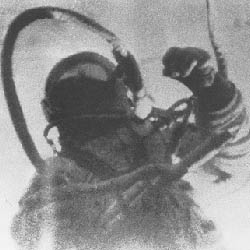
Alexey Arkhipovich Leonov
Fou Roux—the pulse of life
17 March 2k9
“Mad Poet” you say? Fair enough, I’ve been called worse: leftist rabble, uncompromising eco-nut (as former AK Gov. Tony Knowles once quipped. I replied that it was better than being a Corporate Pimp…), arrogant radical, insane, disabled, cantankerous agoraphobe, chronic misanthrope, and of course, a fool. Before long, if you read long enough and stay with me Dear Reader, doubtless you’ll end up calling me worse as well. It’s sort of an occupational hazard. To be a poet, and still be able to face yourself in the mirror, one has to step on some toes now and then, rattle some cages, climb way out on a limb and start sawing behind you.
17, March 1901: an artist, whose popularity had been growing for some years, was given a grand exhibition in Paris; which could have been the big break for any artist, except this poor soul had already been dead for eleven years. Following this retrospective, and subsequent others in Amsterdam and Cologne, the work of Vincent van Gogh became known to the world. His influence rippled outward and is felt even to this day, more than a century later.
What we know of the man himself is often shrouded in misery and mystery, only lending strength to the legend of a tortured, mad painter; a man whom the people of Arles, France came to call Fou Roux “the redheaded madman”. Despite decades of conjecture by doctors, scholars, and pretty much everyone else, we’re not much closer to the truth of what happened to Vincent now than we were in the days following his suicide. And while it is hotly contested, many do not agree that suicide is necessarily a good indicator for what is loosely referred to as “insanity”.
Who can say if Vincent was truly mad, mentally ill, permanently slipped off of his cracker? And if so, is it really any of our business?
For reliable information regarding the myriad of questions in this debate, I recommend exploring the admirable work of David Brooks at: www.vggallery.com. There you can find a succinct biography, qualified historical analysis, and most importantly, good representations of his art as well. Further, it is the only website sanctioned by the museum itself, so you know they’ve got the straight goods. If you dig around in the visitor submission/poetry section you can find a poem there by yours truly. Guess which one it is and I’ll send you a donut. *limited to 1 (one) per household.
I chose to begin this journal on this date as an homage, as Vincent has inspired me through countless hard times. In the palace of my mind, his work adorns the walls. It forever shows me something new and surprising about myself, about how I perceive the world around me.
His perseverance in the struggle with his own demons; his dedication to his craft, no matter the cost to his own comfort; even his failings, which so many of us share, that would not stop him from creating some of the most challenging and beautiful art in history—these lessons have taught me, often painfully, to grapple with my own work: what does it mean, exactly, to be an artist, or in my case, a poet?
I still haven’t the foggiest clue, and that is the only honest answer I can give.
Other than similitudes, no gathering of words fully answers the question.
Perhaps in your own mind you carry a definition. But tell me, do you feel that it is complete?
Confusion waxes and wanes. Lately I have stopped asking such dangerous questions.
I have been listening instead, straining to hear the quiet voice guiding me deeper through the labyrinth, to the temple where my Muse sings her arias…
Poke an artist and many will tell you we do it simply because we have to.
We seem to feel a duty to our art that transcends mere ego:
revealing the best and the worst in all of us, it is a siren song of creation—
a daybright beacon in the darkness, composed of hidden symbols;
a cerebral conduit to the heart of humanity, without which we would be hollow and bereft.
Yet while connected to it, we feel the pulse of life.
~*~
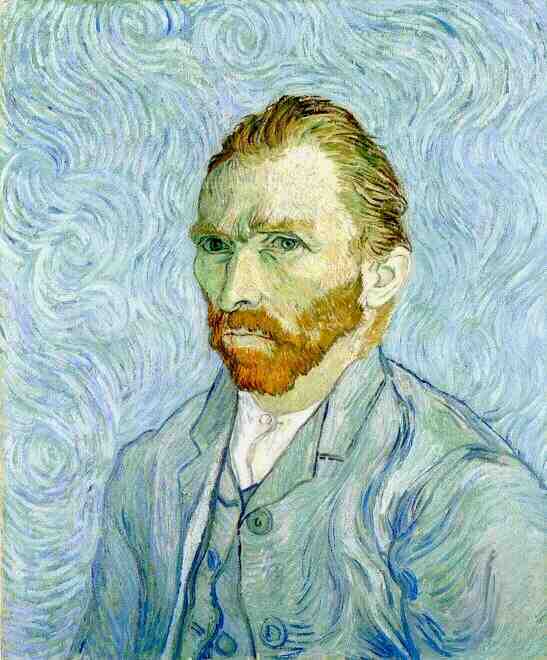
Vincent van Gogh—Self-Portrait, Saint-Remy, September 1889
~*~
—end transmission—
Under Construction
Welcome. This space is under construction, Please Stand By.
 Dawn Runs Amok